References
Assorted reference information
Symantic Versioning
Uses 3 numbers, seperated by a period. e.g. 1.2.4
Breaking changes . New features . Bug fixes
Express
Definitions
- Express JS is used to handle HTTP logic
- Express middleware is a function which runs between the request and response.
- Express-Validators validates routes according to business rules
- EJS is a templating engine for injecting data into View files
Express Middleware
- Express.json(): (Built-in) Parses incoming requests with JSON payloads
- Express.urlencoded(): (Built-in) Parses incoming requests with URL-encoded payloads
- Express.static(): (Built-in) Serves static files
- Morgan: HTTP request logger
- Cors: Enables cross-origin resource sharing
- Helmet: Secdures express apps by setting HTTP headers
HTTP Methods
| Method | Code | Purpose |
|---|---|---|
| GET | 200 | Fetch data |
| POST | 201 | Create data |
| PUT | 200 | Update record |
| PATCH | 204 | Update partial record |
| DELETE | 204 | Deleted record |
| ERROR | 400 | Bad request |
| ERROR | 500 | Signifies server error |
Examples
Code Implementation 200 Get record or record 200 Full record updated 201 Record added 202 Request received for processing, but not completed 204 Partial record update completed (No content returned) 204 Record deleted (No content returned) 206 Partial content 300 Redirect 400 Rejected API call - missing required header 401 Unauthorised request 403 Forbidden 404 Record not found 408 Request timeout 409 Rejected API call - Operation in progress 422 Rejected API call - Invalid header/data sent 500 Internal server error 503 Service / Server unavailable (e.g maintenance)
Model - View - Controller (MVC) Pattern
Can be server, client, or both.
- Model
- Data that is required to populate a page or control (partial)
- View
- The page, or partial page, which will display the information. (Often EJS)
- Controller
- Needed to render model data to a view, or partial. Which handles any API calls for CRUD or to external sites, and for managing any dynamic functionality on the web page.
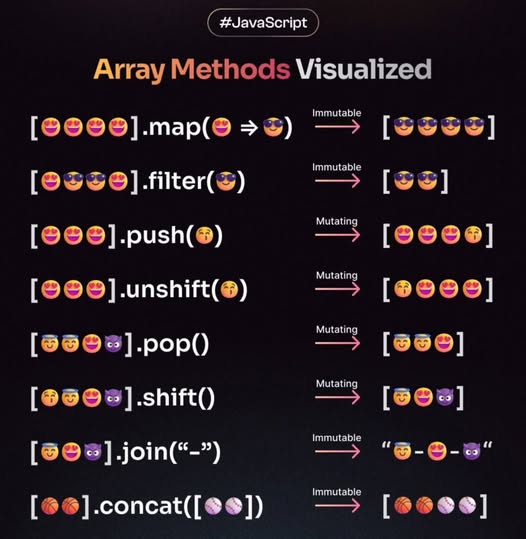
Array Methods
API Terms
Definition
- Enables communications between software systems
- Defines structured rules for integration
Endpoint
- Represents specific API functionality path
- Unique URL for accessing resources
HTTP API Methods
- Enable standardised CRUD operation handling
- Define action performed on resources
Request
- Client sends structured data payload
- Includes headers, parameters, and body
Response
- Server returns processed result data
- Contains status code, and payload
Status Codes
- Indicate outcome of API request
- Help identify errors and success
Authentication
- Verifies identity of requesting entity
- Uses token keys or credentials
Parameters
- Transfers additional data within requests
- Support filtering, sorting, and pagination
Headers
- Carry metadata about HTTP requests
- Specify content type and authorisation
Authorisation
- Determines user access permission levels
- Enforces role-based access control (RBAC)
Rate Limiting
- Restricts the number of allowed requests
- Prevents abuse and server overload
API Key
- Unique identifier for client access
- Used for simple authentication mechanisms
JSON
- Lightweight structured data exchange format
- Commonly used in REST APIs
Webhook
- Sends automated event triggered callbacks to a URL
- Enables real-time system updates
oAuth
- Secure delegated access authorisation framework
- Issues tokens for controlled access